"Who are you?"- The only thing to muse over, While I wait for time, Too fast, too fast, to catch- Late, again? Always. Time smiles and dies away.
The date is set in memory Of a bright, near moon Casting a shadow
over the awe of it. Oh, but I ache in codeine cups, Spewing tears out ducts Down runways, well worn lines- Aging speedways
to the high teas Of my long, long, journey.
After they finished fighting The war to end all wars, And before they fought
the next war All the king’s soldiers and What was left of the king’s men Couldn’t put the world Back
together again.
Russia turned red and The new world sighed. Austria Hungary broke into So many pieces that Even Rand McNally was confused and Influenza riddled the continents Further
thinning the globe.
The British still had their empire Including the gem in the crown and One would think there was no Further
appetite to mow men down. Alas, No. What was left was as cattywhompus As the price of bread and the cauldron Still bubbled for the want of Mars, the god of war.
E. D. Ridgell 2019
Somewhere on Silver Beach In Exmore Virginia under A mountain of
cutzu Is a small roughly hewn Stone marker on which Is carved
the name of a single Child aged less than one year Who died and was buried there In the middle of the nineteenth century.
It’s
a sad little forlorn marker With no other around it, But it is testament to a Parent’s love and grief. I came upon
it In the middle sixties When I was still in my youth. It’s
lesson for me was the assured reminder That “in the midst
of life we are in death”.
E. D. Ridgell 2019
“Got to scrape the shit right off your shoes”- That’s Virginia, wild fields of forgotten hemp That served to make the rope that you could use to Hang yourself
if you’ve half a mind and the pluck.
With luck you’d score weed in days when Bags cost five
and the seeds came with it. A trip was as easy as roasted morning glory seeds- The high more colorful than mescaline
and not as earthy.
Sex was easy and greasy and rubbers were dispensed At a quarter a pack. Poppers were
real amyl nitrate And hearts beat to The Rolling Stones in Jagger-tight jeans- Life was music sung to the mantras
of incense sticks.
The lady and I didn’t enter a room. We occupied it! When the kid came she was to
Bradley coaching and I was one of the first allowed in the operating room- All this was a half a century ago,
sands in the hourglass.
Clifton Park
That it was here
A hub, one of several
Around which events of my life turned-
Clifton Park.
I remember being struck
Side my head by an errant softball.
None of the grownups cared.
I was an unattended child.
On
Saturdays,
We young
gun slingers
Might catch
a Western
At the Hartford
Movie Theatre,
Opposite
the park.
Cowboys and
Indians, fifties fare for
Young, eager, TV anchors.
Hartford Road,
striding the athletic fields
Was to become a fixture in the landscape
Of my early years.
I recall the Sears
On Hartford and North.
Mom and Dad
Had
an apartment on North Avenue
When I was but two or three.
Dad said he would walk me
To a zoo and a park, top Druid Hill.
I vaguely recall the
Amusement park, hanging chads,
Faint memories, all near Clifton Park.
Early
in my teaching career,
I
taught art in a stately building
That was then a junior high school-
Clifton Park Junior High School.
I lived near North and Twenty Fourth,
A short drive further into the city.
I knew the very streets those
Nigga's walked and played on.
It was a bond to my love
Of the Black community-
Every
early summer
A dignified
graduation
Would echo
forth
“Lift
Every Voice and Sing”
Out
onto a manicured Clifton Park.
That we should
meet, casually, here,
Twenty
five years later or more-
Making
our trade amiably.
You let
me
Think you were
dry walling a house,
Perhaps
taking care not to
Disillusion
an old man-
This, of
all spots, the very place
Where
I brought that
Summer
camp I taught to swim,
Of an afternoon, walking
Them over from the school,
Clifton Park Junior High School.
All of this stirs memories.
I cannot think
that
I will leave
this life, as old as I be,
Without
somehow,
Someway, gazing
out just once more
Upon
that lovely, green vista that is
Clifton Park.
E.
D. Ridgell
__________________________________________
Still Standing
Sitting with my small bowl of strawberries,
My mind channels back to a time when I
had a first fight-
Not fisticuffs,
but worse, words-
A laddie-boys
fight over whether or not I could fly
Off the end of the picnic bench like Peter Pan…
“Yes I can.”
“No you can’t.”
“Yes, I can, yes, I can, yes I can.”
“No you didn’t. You’re lying.”
“Who you call’n a liar? You can get out of here.
I hate you.”
“Well, I hate you more, and I will”.
So all of a sudden Joey was gone and
I was left with that huge colander of red berries,
Bawling away, tears running down, and me
Eating every last one of those strawberries,
Stuffing my sorrow, stuffing my feelings
Not for the last time.
That was in nineteen sixty and Joey died a few years ago,
I’d been liv’n out the car, It seemed like forever, When it up
and broke down- Not even occasional heat.
House sited, pet sited, Old people sited, whatever Would earn something, Anything for a day.
My folks wanna help But they’re want’n
too. Sometimes I question the Almighty Which does mighty little.
I
found the puppy and Him and I, we have something to love- Ya need something to love, Otherwise ya start to feel hollow.
Whatever’s
for ya Won’t miss ya but I surely wish I hadn’t had To
find that out tha hard way!
E. D. Ridgell
_________________________________________________
Cape Fear!
Cancer!
Now that I have
Your attention.
It’s visited mine
Throughout a lifetime.
I cannot help but fear
Next visit is mine!
E. D. Ridgell
_______________________________
Taxing Matters!
“Are the taxes done?”
These were the last words
Of my grandfather.
He and my grandmother died
Just
ten days apart o’er fifty years ago, now.
Five decades
later, I muse as I render unto Caesar.
Grammy suffered horribly.
He kept up the family tradition
And died of a stroke.
The
mammies were suddenly busy
Stuffing smoked ham with kale,
A Maryland tradition.
We were filling up holes back of St. Mathew’s
Fast as they could dig them close by unmarked graves,
Lost babies to Grammy’s salad years.
I muse to just how many
more tax forms I’ll file-
Tedious American rituals,
these
Taxing matters!
________________________________________________
Like Sebastian
It is a pain
Second only to one far worse.
I
hold on,
And so, I
Serve people for whom I am
Of secondary purpose.
I keep going
On and on and on
While others drop away.
I am afraid I will be the
Last one standing.
I would have you lay me gently down, please.
I am not blind
to your sufferance,.
Humbly and gratefully,
I plea
As I skate boldly
On thin ice.
I
am always
The risk taker
Trusting that You,
The Director,
Will keep the measure
Of me.
Holy Mary,
Mother of God,
Intercede for me,
A sinner.
Blessed Maria.
Look down upon me.
I would that I could
Find a monastery
Where, like Flyte,
I could
Retire
from
This field of battle.
Lay me gently down, Lord.
Dimwitted
Dozing through the debacle, Some seeming decline Drains my energy. I am At
the door of depression.
Duplicity drags decisions Downing down government. There are drafts developing, Underscoring a nation’s descent.
The demise of debate Dopes discourse, Dodges answers, Dumbs a demanding press.
Dangers are everywhere, Divisions grow wider, as The duped drag democracy Ever-closer to disaster. E. D. Ridgell 2018
_______________________
The Deep Wound
It was such a deep wound A great resentment tagged it. Nothing has shaken it In half a century.
There were so many wounds Bursting out all
over, I suppose, no I know, Each took a talisman.
Yet, more
suffered more Than some and that was, Somehow, a wound of its own. Great
restraint was needed.
I cannot explain my confusion. I fed anger with self sacrifice. It was a sort of masochism, That failed
to temper anything.
Now decades later one lies cold And the others got religion. All in all, I find it distasteful but Reprisal
is wicked. I’ve never been that.
When I think,
but then I think too much. What wisdom I’ve garnered
these years, You’d think it would suffice, yet no. I would companion this mascot to hell!
E. D. Ridgell, 2018
I’ll tell you something While
I am waiting on God: There’s no better gift to give to
family Than what history you recall.
Don’t think too That nothing is lost. It is lost no sooner
than your gone. It’s an old story that no live wires
can fill.
The truth is in the putting So pray Jesu you writ it down. You writ it down ‘fore your drown downing ‘fore you know. Death waits for no one, aye.
‘fore
you know the sickle is swung, The bell tolls and it tolls for
ye. Go in peace aft ye leave said token, A token of love if ever there be one, aye!
E. D. Ridgell, 2019
Primary Colors is written in the "voice" of a Missouri Raider, a Confederate sympathizer
who is actully setting up a
tradition that would become
a horrible and unjust form of murder in the nation throughout the later part of
the 19th c and early 20th. I think the artist here best describes it in the "blues". After
listening to the UTube
video just hit the back arrow in
the upper left hand corner of your computer to stay on site.
<iframe
title="YouTube video player" class="youtube-player" type="text/html" width="480" height="390"
src="http://www.youtube.com/embed/h4ZyuULy9zs" frameborder="0"></iframe>
Written in the voice of a Missouri,
Confederate raider in 1864
______________________________________________
Primary
Colors
Waning bluebells wilt
Another hot, Missouri day
As a red-winged, black bird
Perched on a cattail,
Takes fright and flies
For the closest clutch.
A field sways mustard
Backed by a blue sky,
Next a blocking,
brown marsh.
“Go on, then!
We’ve ruddy deeds to do
Outfitted in our hothouse,
Uniforms of sweaty gray!”
Straitaway,
Sighted shots send out
White, puffy clouds
As naked, lead sings through bits of blue
Stained red with their swift stings.
Shrilly they cry,
Then die, easy marks for the kill-
Blue prey, with
yellow bellies
Spewing and oozing red.
All lay dead save two,
White eyed, blue-bellied coons-
Hands flap!
Mouths yap!
“Neck them low from
Yonder red bud tree-
Take this hemp rope of pale yellow
That hangs from
a readied ring,
Wound round and hung down from
Side my chestnut, steely, steed.
Part it evenly. It'll do,
And we’ll be fair in what we share,
As red tongues swell
Outta our high-yellers gone blue,
Collared and yanked to Hell!”
There is nothing that has caused me more frustration and, in some cases, outright confrontation,
because some readers do not understand that the "voice of the poem"
is not always the "voice of the artist".
The "voice
is a vehicle" that can be maniupulated in many ways to do many artistic things.
Here is a clip of Whoopi Goldberg, an artist whom I identify with a great deal.
I think her "Parrot Joke" best illustrates what I'm trying to say...Ed :)
My Islands of Smith and Tangier are Sinking
The salt waters are rarely
more than three feet deep in a hundred mile radius of what remains of the islands, making for the richest breeding
grounds in all the world for their prized, soft shell, blue crabs. The Bay seems so calm. Everyday washes a little
more away though with an ever faster beating and tow, an unkind progression, quicker than in the decades before. The
erosion is inevitable and the shrinking so very visible as my beloved islands of Smith and Tangier, dubbed, “ Islands
out of Time”; islands of the lower Chesapeake Bay, islands of my ancestors, islands of my roots, go sinking.
The communities are shrinking with the young anxious to escape to the mainland. A few, the hardiest, do not want to go. It is in the blood, this feistiness: a tenaciousness born of centuries of holding on. Those
that take the mail boat travel light with heavy expectations. Some never return but most do, at least for visits
that start at first once a year for the annual camp meeting, and then become less and less frequent as if to emphasize
the receding sands. They bring back foreign sounding words and a twisted way of thinking. Everything is said in
a straight and unimaginative way. Speaking in opposites as is the custom is forgotten. There is a fainter resonance
in the Elizabethan “a”s and they talk so fast, almost in a chatter that takes the breath away. The
cats run under the boardwalks in search of silence and to escape the mainland smells.
Those that are island
bound don’t mix well anymore with these. The one have nothing but the optimism of the day, the other have everything
in a pessimism of the times. The one drink on the sly while the visiting relatives no longer know the value of a lie.
The older islanders politely pretend to listen, their thoughts lost in the crab shanties just feet away. Everyone
though comes together in the big camp meeting tent. These islands are Methodist and Joshua Thomas part of their history.
The name Wesley is still common. These camp meetings held in the single huge tent have always been the biggest
event of the year. Some things are primary, so sacred they are inviolable.
It is then that the bond is felt
again and rekindled. There is no blame, and even if some forget to speak in opposites, that odd tradition of saying
precisely the backwards version of what you mean to say, the truths no matter how spoken,
straight or twisted round to need unraveling,
they still ring true. They are inherent in things primary that even separation will not eradicate; values set
in the cement of faith, optimism, and an acceptance that in the end the storm passes and the sun breaks through.
Everything passes away except things primary; things not bound by any boundaries or no less solid with the caresses
of the sea. They can’t be covered over or washed away. They are buoys that mark the channels and point the
way safely into any harbor, any harbor you may find yourself sailing into, island bound or not.
Swaddle me in the religion Of my forebears- The whispering chants in Latin, The brightly colored, church vestments, The magi’s aroma of incense.
Once
again, me kneeling ‘fore Our Lady In intimacy with the
Madonna- A childlike trust in secrets Wrapped in blankets of blue and white Bedazzled by Her golden light.
Carry
me to tarry again in prayers To temper a child’s confusion- The solidity ‘fore a plaster facsimile, Her gaze imparting boundless gentleness, Trusting all that is feminine and pure.
Áve Marī́a, grā́tiā plḗna, Dóminus tḗcum. Benedícta tū
in muliḗribus, et benedíctus frū́ctus
véntris túī, Iḗsūs. Sā́ncta
Marī́a, Mā́ter Déī, ṓrā
prō nṓbīs peccātṓribus, nunc et
in hṓrā mórtis nóstrae. Āmēn.
E. D. Ridgell 2019
Blinding, Bordering
on rage, Co-dependent co-habitation, True love aches For the father, the
hero, and the lover.
In the tomb Of the unknown Lies a statistical
possibility. Stir in Jesus and You have a probability.
I snuggle
up Of a night To the decorated veteran, The father, the hero,
and the lover. It is a story as long and as ancient as that
love That dare not speak its name.
E. D. Ridgell 2019
Beg pardon. Never
promised some rose garden. Who are you to question me? What, are we doing- Trading bubble-but insults now?
But another’s
head. I’m about reconciliation. Come together right now Over me! How did you come to Trinity? In death you up and separate? It ain’t
fit’n. It just ain’t fit’n!
Whose gonna
milk This here cow? It ain’t me. It ain’t me You’re looking for.
I never promised you A candy cane
ass A bubbling up, bubbling up A Kansas tornado Dripping down your
fat leg.
Angie, Angie- Your kisses still taste sweet I hate
that sadness in your eyes, but Angie, Angie- Never promised you a rose garden. Angie, Angie, I’m so old. Ain’t
it time we say goodbye- Ain’t it time we just die?
E. D. Ridgell 2019
At the parting plumb me Like a shadow
upon the ground, Cast by a stately palace before the sun. Lay my ashes gently down Upon green grass within the circle round. Catalpa
trees shall feather me, As footfalls of citizens come to Promenade peacefully as to Pay due homage to past pedigree. Throughout
the colonies you see The cast markers, monuments to martyrs, Some unnamed who gave the full measure That I might have this bed, a tyrant's placemat.
Let dustings of me, Meander to mingle With that much loved Bone and ash Strewn by me so long ago In this perfect spot- The place we strolled in Salad years of genteel
things, Paint swabs, and hand picked boxwood. Nestle me down in rich sheep dung, To sleep the sleep of patriots. God bess this
bountiful land And forever plumb it to Liberty.
c. E. D. Ridgell, 2019
I wish she would leave me in peace, the muse. Of late, she’s always at me at me at me Stirring up memories, sifting and sorting them- Launching
them toward hard copy.
Some sixty years ago, a solitary,
lonely boy Sat one night in the Waverly Theatre when Suddenly a stranger, a man, parked himself Beside the boy a loaded jacket in his lap.
The shoe was first, then a knee, All the while the
jacket was still until A hand eased out. The boy, young, Dumb, and full of cum eased out of his seat.
I went out by a back door. As I say I was dumb. He followed, of course. He wasn’t
coarse but rather vanilla considering So far he’d
been two scoops of Rocky Fudge.
He wanted to drive
me somewhere. I said “no”. He said “please”.
How does a boy make all the right decisions? I just turned,
and fumbled the half mile or so home. I’ve always wondered
if the movie had a happy ending.
E. D. Ridgell 2019
My Spaniard had the perfect ass. I say that dispassionately. I used to admire
him walking away, Something alas, one day he did for good.
I could have stopped it, turned it around, But truth is he was lost in mid air. Like
me he was charting a divorce Not an auspicious time for
either of us.
I saw him from a bus months later In front of the central library. I made no effort and he never knew How
close he had come to taming the ball.
I don’t know
why, a mixture of curiosity and nostalgia But I’ve
googled him down. He made it to the Big Apple And is
counseling needy Gays now or something like it. He still
is hopelessly helpful I suppose.
Forty years ago we were
in Spain and in love. Franco was living Although just. The
Spaniard wanted to be an actor. He was Hot blooded and
he had the ass for it. I’d say something about Two
paths and a divergent wood but I mustn’t. I really mustn’t.
E, D. Ridgell 2019
No Need For Mixed Media Or Metaphors
And yet, …Lorca and Dali Juxtaposed- Before the last master, Rodriguez.
Mix it up- Make and match. Pugnacious
and rebellious, It’s like him to drive Into a nest of Franco’s fighters.
How then to turn the poem? Paste
a pic with links to Tinged words and masochistic needs- No limitations! None!
In 2008, planes overhead dropped Facsimiles
of his white-winged sonnets And Spain sobbed, weeping decades
later- Too many with memories.
Mix it up? Yes, mix it up. They shot
the muse in the ass, And then the whole world went to
war As though summoned to anarchy.
E. D. Ridgell
Revised 2019
Johnny get you gun, get your gun, A rum-tummy, tummy, tummy tum. It
ain’t over till the fat lady sings And she’s got
high in the sky hopes, Miss American pie, do or die hopes.
Put another nickel in the nickelodeon. The nicest part of any war is that look, That
look in his eyes when you stick him, Throw’im a kiss
and twist twist twist- It’s all in a day’s war,
my son.
Johnny get you gun, get your gun, A rum-tummy, tummy, tummy tum. It ain’t over till the fat Lady’s sings And she’s got high in the sky hopes, Miss
American pie, do or die hopes.
This’ll be the last
one. Would I lie to you son? You’ll see. You’ll be home by Christmas- Noel, oh well I never promised you a rose garden.
Johnny get you gun, get your gun, A rum-tummy, tummy, tummy tum. It
ain’t over till the fat Lady’s sings And she’s
got high in the sky hopes, Miss American pie, do or die hopes.
E. D Ridgell 2019
_______________________________
Shoot The Dove
I am stuck, A
disabled bundle of creativity Waiting around for the
sickle thrust. It only hurts when I feel And I am forever feeling.
The tiny cells Dwell on big fears Made bigger by the times, A gentle man in an ungentle time- Trying
to figure out which button is the safety.
If only it
were about me- Lo it ain’t though. Too many Sentences coming at me All beginning with ‘You’- Fuck
you!
Words used to glow. Now all is muddy “Lovely, dark,
and deep”. Everybody’s pack-in ‘cept me. I never could shoot the dove.
E. D. Ridgell
Chrysanthemums
wane heralding season’s end. Days
grow chilly beckoning in Rituals
of gathering wood for firesides to tend- Musings portend cozy evenings side the kin.
Soon the snows will drift o’er the land Sculpting contrasts in windy rows that shimmer so. Skaters cut eights as ice fishermen tan- Children warm hands round rusty barrels aglow.
But with the cold fears stir At the fallen twigs too thin Swiftly tramps hop trains south to avoid her,
I died some time ago But you did not notice until now. It was inevitable And inopportune So I do not Hold it against you.
I just managed the Last Rites Although barely conscious. My pain was embarrassing And distracting I did not notice your
absence.
Try to have a painless death If you can manage it. Have your affairs in order. Let people know What you want done with The left overs!
E. D. Ridgell 2018
_____________________________________
Inca Incantation
The rope bridge Of
woven grass Rests ready for offerings Prescribed by the gods Generations
ago.
The gap is wide The fall deep and deadly- Nerves taught
in anticipation For priests to bless The toothless woman’s walk- The eldest stateswoman. In an ancestral
rite from Before armor-clad horsemen.
A mountain ritual of Tribes so high in the sky As to be inaccessible to Hooves of invaders- Bespeaks a tradition Meandering back to origins Forgotten but never rued.
E. D. Ridgell 2018
_________________________________________
So Lay Me Gently Down Now
He’s been dead now these many years
And yet
his obit still hangs there
A haunting reminder of
Just how much I loved him.
I don’t think he ever thought I’d leave,
And
it was that complacency that laid the seed.
Decades later I muse on those
days,
My days of wine and roses.
So along came the kindest man I’ve ever known.
He clipped my wings as the wood-be priest had warned,
And
“I went off to Babylon against that Nidintu-Bel
Who called himself
Nebuchadrezzar.”
In
but a little while they’ll lay me gently down
Under the catalpa
trees that were a second home to us
Those many years when God seemed to abide
by me and
Before these pancreatic ghosts that haunt me.
Old age is the time for meeting God or a
facsimile.
Whether there is a God or not is of little consequence
Modeling a flagging medal below the Mason Dixon Line, Big Daddy was given a
warm Buckler hastily chilled by ice cubes snapping quickly. Big Daddy is triggered at the sound of cracking. His needs require preparation and some consideration for denial.
Big Daddy expects applause if not
standing ovations, so heckling was a surprise almost as extra large as the expletives thrown at his second
coming.
With seeming aplomb and appropriate rhetoric prepared for just such an occasion, Big Daddy, a
practiced magician, commanded the ice cubes vanish amidst the yanking and yapping of division, and he got
his standing ovation from the applause of the ever faithful;
My chest
was open to him and my back feared nothing.
We were young Dads with like aspirations.
Each
week we smoked peace pipes together.
We swam naked of nights, cool water
on young bodies.
We made art as gifts for one another.
I was young. I trusted as only the young
can.
I was naive and cherries were being plucked a plenty,
No less mine. The ropes were twisted and loose ties come unmoored
No mater the raker. She was so ripe for plucking, she turned my stomach.
In truth anyone could have had her, but why would he
Make a mockery of his own chaste house?
Why had
I wretchedly succored, in manly surrender one unworthy?
What's for you, won't
miss you, and he had been for me.
It stings me to this day, and yet, I confess,
he still charms me.
The
worms feed on her and we are on the menu.
It is all sorted out on the surface.
I am mated properly and happily, and
He's
still in a married bliss that is stable.
The blood cools with time
and with it the duck's blood thickens.
c. E.D. Ridgell, 2015
CLICK ON THE LOWER LEFT ARROW
TO WATCH THE VIDEO
The Robber Barons
First, they moved the noble poplars and the tall pines, stripping the hills in only a generation.
Tempered now in greed, next, they proffered to pitch their
tracks to a greater tender; these barons of the rails; robbers with newly purchased “n” rights. They sent hireling men, many a former logger and lumberjack; the hill men, underground to scout out Salley’s
find; for profits suspected to lie beneath the bruised, and full-bellied Appalachians.
In the passages
dark and dangerous, the shaft-sinkers found seams; black riches beyond greediest expectations. With industry
and speed the company owners, representatives of barons back East. soon had the recently discovered seams yielding rich loads borne out on long tracks. Too few though were tracking the robber barons.
The wheels turned;
whirling in all directions. It was an era when immigrants proved profitable; an agitation invested into this brew
of native, negro, and the new benefited the “Man” and seasoned the company store still more. The rich and slick soon had all in a kind of slavery that incited a wretched worker, often a family man, to strike, temporarily shedding soot stained, hard hats their shiny lamps symbols of that servitude.
Fields strewn with tents soon housed the dispossessed united to work for something fair, anything freer feeling. They never stood a chance. Strike after strike failed and in the end they had to await “Big Bill”
trailing his friendly, “Teddy” bear, both finally checking and tracking the robber barons.
Victory came in an act. Robbery that rude and reviled, successfully railed against was thought to be relegated
by law, put to past.
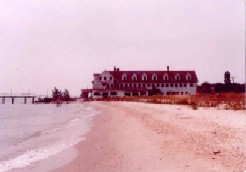
Point Lookout Hotel Torn Down By The State After Taking The Land For A State Park
‘Up
the Road’ from Point Lookout!
I went ‘down the road’ alone wanting no living company. I checked out the gravesites at Trinity in St. Mary’s City and those ‘down the road’ at St. Michaels; buried Dad’s old Ronson lighter in the Judge’s chamber and planted tulip bulbs a few feet away in
the recently turned soil of her grave.
I drove down to Point Lookout before going to the house. The Point’s
too changed to care much anymore but I did; I cared a great deal at the desecrations of what had been the best
memories of a childhood not very blessed. We’ve ne’er been folk to lay our resentments down easily. There
are fewer and fewer now who remember the white, clapboard, naval hotel, three stories high, with its long pier,
jutting out over the Potomac, and the small surrounding community of cottages; all bulldozed decades ago making
way for black, asphalt, parking lots and sandy, stucco, bathhouses. It was then they seized the Judge’s
land in the name of a state, we knew more about what parts were wise to waist or waist not. We still do. Those
publican funded outhouses erected in the name of progress were locked that day against the coming winter, their
graffiti covered, fleck painted walls, hissing defiantly back at the pushing winds. It was fittingly chilly even
at high noon on that early November day. Anger was a warm salve for cold, wounded memory.
I climbed
up into the van, said my goodbye to the ghost made redundant, and headed ‘up the road’ and over the
causeway at a speed I remembered Cotton would have dared and took that curve for a last time and held the road, with
a rebel yell; eight cylinders and gas at three dollars a gallon! Go to Hell! Ten minutes later I was to the monument
for the confederate dead who died in the prison camp that had existed and vanished just ‘down the road’
at the Point long before all that I had just conjured to recollect was built up and then torn down in its turn. History has ne’re respected man-made changes to geography.
I’ve read those bronzed names for so many
decades now in search of some connection, just for the sake of community, but to no avail. They are planted in
a garden too far from home left to our responsibility. The family homestead this last century lies just across the road,
and it is to there I now hesitantly turned to tread with a unfamiliar fear for the future; to the old,
one room, Victorian school-house added on and onto, one room at a time, until it had become a nursing home floating
on cinder blocks settling into sandy soil; shaky pinions but firmly planted with the conviction of an intention to stay.
That stay had now come also, in its turn, to an inevitable end finished with the sign marked ‘sold’
at the end of the drive.
Surprisingly the door was locked. We had ne’er locked doors. I broke a window
pane and entered through that kitchen that held such a cauldron of stirring recollections of family matters played
out to an audience of colored women cooking on black and white enamel stoves under Miss Sophie’s supervision,
her manner intimidating everyone. Even my formidable grandmother was temperate in her own kitchen. I won’t
dwell on the food; paradise lost. I took a sad last tour, through the bedroom where I remembered Mary Allen brushing
my Granny’s hair, unbraided to the floor, and on through to that bedroom where Dad crossed “over the
river to rest under the shade of the trees”. All the rooms had something to say but in the end it was all goodbyes.
The grounds, mercifully, were much changed. The sty was gone, the ghost broken up for it’s cypress, the
chicken houses long ago torn down. I ne’er did know what happened to Dad’s beehives that he started and tended in the cancerous months leading up to his death. Her garden was there, though, so recently tended and
already so quickly grown over. That’s why I planted the tulips for her in anticipation of next spring. My aunt
always looked forward and ne’er back. I must try even now past that halfway buoy to master this.
It
was done. None of the children cared enough and in truth it was not practical. All of us through the years laid
down roots too far away to stay. It was agreed upon. It was done. All including me were ‘up the road’
and too far away. It was done and gone so quickly. Who wrote, “haste makes waist”?
I drove the
length of the drive and stopped at its end before turning to go ‘up the road’. Stepping down out the
van I scooped up a handful of soil and ‘Little Butch’- ‘Ed, Junior’ put this in his dungaree
pocket, the left backhand pocket reserved in any pants since childhood for such treasures. I have no idea what
I will do with this rich and loamy soil, but it is a physical memento of a family’s ups and downs, it aspirations
and disappointments, its happiest and saddest moments. It holds memories and secrets that will forever go untold.
Just canvas the ghosts of the many dead, naval veterans who still haunt these acres, or if you dare ask Cotton’s
spirit back ‘down the road’ at the causeway curve he finally failed to turn on two wheels, or try to
pry from me all I know. No, it is done. It is that side of history that is lost with every goodbye.
A scholarly sojourn down pedestrian aisles, bordered with slight variations in form and style, and there
it is, one more cold marble slab chiseled with data and dates, shadowed recesses, of a hot Maryland sun.
Under this stood, a lovingly laid out playground of little plastic toys in blanched colors that
would not decay or rot.
Between the neatly combed rows of yellow daffodils stood the many memories,
mementoes beginning with a blue airplane, bordering a purple dinosaur, and in a second row a brown pony, and a pirate’s dagger to pierce the heart.
A little imagination conjures him up to play again, his
fair, sandy hair, now resting below in the dark, unbleached by the Somerset sun.
Death presents the living
with unwanted tests, whims of the fickle fates; doling out check-offs until in the end all are passed.